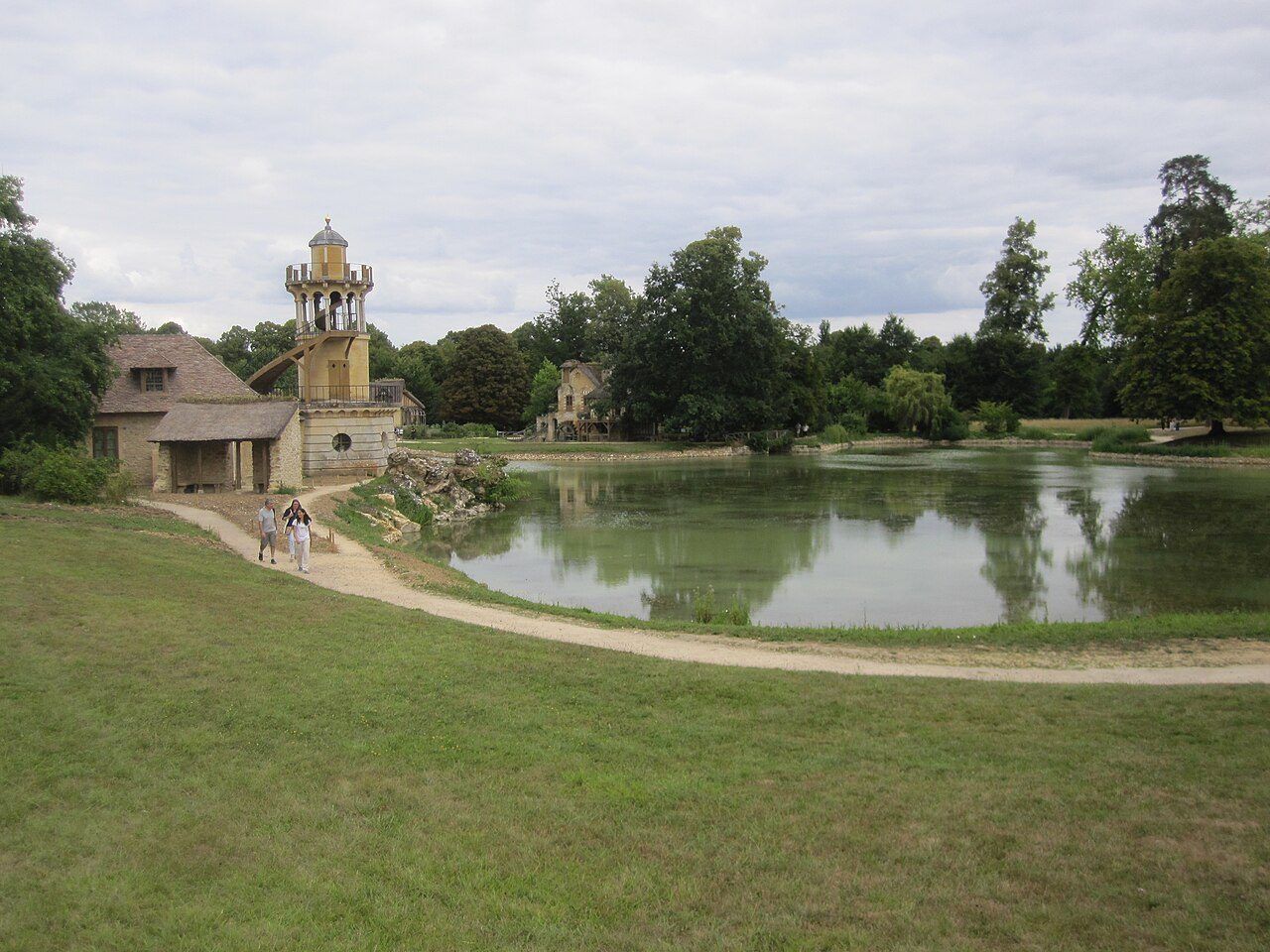
Half a mile north-east of the Palace, past the Grand Trianon and through a screen of trees, a lake curves round a cluster of thatched cottages. A stone tower rises above one of them. A dairy stands beside another. A working farmyard — with real sheep, real cows, a real vegetable garden — extends behind. This is the Hameau de la Reine, the Queen's Hamlet: the strangest, most personal, most misunderstood building at Versailles.
The commission
Marie-Antoinette commissioned the Hamlet from the architect Richard Mique in 1783, when she was 27 years old and had been Queen of France for nine years. It was built over a four-year period on the grounds of the Petit Trianon, the smaller pavilion that Louis XVI had given her as a private residence in 1774. The Hamlet cost about 2 million livres — roughly the annual wage bill of the Paris opera.
Twelve cottages were built. Five were domestic — the Queen's House, the Billiard Room, the Boudoir, the Mill, the Marlborough Tower — and connected by covered walkways for wet weather. Seven were agricultural: the working farm, the dairy, the barn, the pigeon loft.
Why?
The Hamlet has been repeatedly caricatured as a Queen playing shepherdess while France starved. Some elements of that caricature are true. Marie-Antoinette did dress in simple muslin here (she called it her chemise à la Reine), and she did keep sheep that were reportedly washed and combed for her visits. She did give performances of Rousseau's Devin du village in her private theatre a short walk away.
But the Hamlet was also a working farm. Its dairy produced butter and cheese distributed to the court. Its garden supplied vegetables to the Queen's kitchen. Its vineyard produced wine. The farm remained in daily agricultural use throughout its history, run by a tenant farmer named Valy Bussard, who continued after the Queen left.
The deeper motive was privacy. The court of Versailles was a public stage on which everything Marie-Antoinette did — dressing, eating, praying, quarrelling with her husband — was watched. The Petit Trianon and the Hamlet were the only places at Versailles where she could invite guests of her choosing (not the King's), where she controlled the guest list, and where she could dismiss courtiers who bored her. That she chose to signal this privacy through rustic architecture rather than a grand pavilion tells you a great deal about the sensibility of the late 1780s — a sensibility shaped by Rousseau's Émile and by the English landscape gardens the Queen's brother had described from his own tour.
The Hamlet after the Queen
Marie-Antoinette was last at the Hamlet in the early autumn of 1789. On 5 October she was still at the Petit Trianon when news arrived that a crowd of Parisian women were marching on Versailles demanding bread. She walked back to the Palace and never returned. She was guillotined on 16 October 1793.
The Hamlet was closed and neglected during the Revolution but not destroyed. Napoleon considered restoring it for the Empress Marie-Louise in 1810 but did not proceed. The buildings were used as agricultural storage through the nineteenth century. Serious restoration began under Napoleon III in 1867 and continued in fits and starts. The most recent restoration, funded by the jeweller Dior in 2018, returned the interior of the Queen's House to its 1788 state — plaster, paint, wallpaper and all — for the first time in 230 years.
How to visit
The Hamlet is included in the Passport ticket (€32) and in the Trianon Estate ticket (€12). See the ticket comparison here. From the Palace, it is a 30–40 minute walk through the gardens, or a €8.50 return trip on the estate's little train. Golf carts are available for hire at the Grand Canal.
Allow at least an hour on site. The Queen's House interior is included in the standard ticket but capacity is limited to approximately 25 people at a time; you may need to queue in high season. The working farmyard is open, free of charge, and children are welcome to look at the animals.
The Hamlet is at its best in early morning or late afternoon light, when the lake reflects the thatch and the tower. It is a strange, wistful, deeply private place — the closest thing at Versailles to an unguarded self-portrait of a queen.