Visiting the Palace of Versailles.
Visiting Versailles well is a question of when, how and in what order. This is the practical guide: transport from Paris, entry, security, accessibility and the sequence that avoids the worst of the crowds.
The Palace of Versailles sits twelve miles (twenty kilometres) south-west of central Paris and is one of the most straightforward major attractions in Europe to reach on public transport. The simplest route is the RER C suburban rail line, which runs directly from central Paris to Versailles Château Rive Gauche station in thirty-five to forty-five minutes, depending on the boarding station and the time of day.
Getting there from Paris
The RER C runs approximately every fifteen minutes from a chain of stations along the Left Bank of the Seine. Board at Champ de Mars – Tour Eiffel, Musée d'Orsay, Saint-Michel – Notre-Dame, or Invalides. On the departure boards look for a train whose destination is "Versailles Château Rive Gauche" or whose four-letter code begins with V (usually VICK, VITY or similar) — not all RER C trains go to Versailles.
The fare is €4.50 one-way with a Navigo Easy card or an Île-de-France paper ticket zone 1–4. Do not use a standard Paris Metro ticket — it is not valid on the RER outside central Paris and you will be fined €50 on the spot.
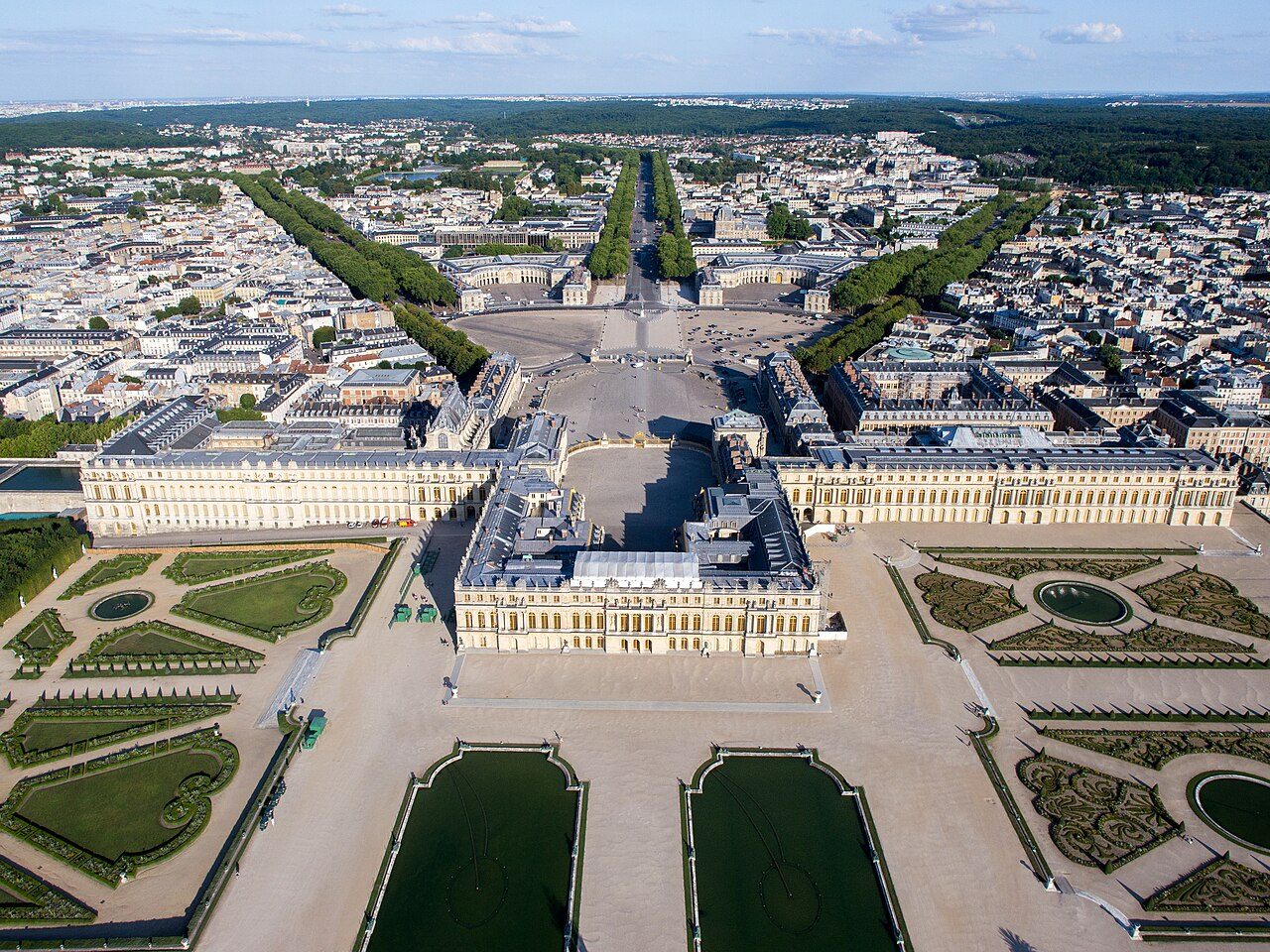
From the station, follow the signs marked Château for a ten-minute walk down Avenue du Général de Gaulle. You will emerge at the Place d'Armes with the golden Royal Gate directly in front of you.
Security and entry
All visitors pass through airport-style security screening at the entrance. At peak times — weekends between April and October — the queue can take twenty to thirty minutes. Off-peak (Tuesday or Wednesday from 09:00 opening) it is often five minutes. Water bottles are permitted; anything sharp is not; drones and professional camera tripods require prior authorisation.
The Palace in order
Once through security, follow the official one-way circuit through the State Apartments. It begins with the Royal Chapel, passes through the six Grand Apartments named after Roman gods (Hercules, Abundance, Venus, Diana, Mars, Mercury and Apollo), and reaches the Hall of Mirrors roughly halfway through. Allow ninety minutes for the Palace interior at a considered pace, or two hours to read every panel.
After the Palace, either walk into the Gardens (free most days) or take the free shuttle bus or petit train to the Trianon Estate, approximately 1.5 km to the north-west. See our guide to the Gardens and Trianon for what to see there.
Accessibility
Versailles is more accessible than its baroque appearance suggests. Entrance H, at the north end of the courtyard, provides step-free access for wheelchair users, prams, and visitors with reduced mobility. Wheelchairs are loaned free of charge on presentation of an identity document. Approximately 80% of the interior is accessible via lifts installed within the historic fabric.
The Gardens are partly accessible on the upper terraces near the Palace but become gravelled and undulating past the Latona Basin. The Trianon Estate has electric adapted carts available to book in advance for visitors with reduced mobility.
Practical logistics
Food and refreshment
There are three dining options inside the estate. Angelina, the Parisian tea room, operates two branches at Versailles — one in the Pavillon d'Orléans (Palace) and one at the Petit Trianon — serving the famous Mont-Blanc chestnut pastry from about €10. La Petite Venise, a brasserie by the Grand Canal, offers a two-course lunch for around €35. The Ore restaurant by Alain Ducasse, inside the Palace itself, serves lunch only.
What to wear
The Palace floors are original 17th-century parquet and marble — beautiful but hard. Wear flat, cushioned shoes. On a full-day visit you will walk between 8 and 12 kilometres, much of it on gravel. In summer, the Palace can reach 32°C indoors; there is no air conditioning in the State Apartments.
Photography
Non-flash photography for personal use is permitted throughout the Palace and the Gardens. Flash, tripods, monopods and drones are prohibited without a written commercial licence. Selfie sticks are not allowed inside the buildings.
Frequently Asked Questions
- How do I get to Versailles from central Paris?
- The RER C train — direction Versailles Château Rive Gauche — runs every 15 minutes from stations including Champ de Mars, Musée d'Orsay and Saint-Michel Notre-Dame. Journey time is 35 to 45 minutes and the Palace is a 10-minute walk from the terminus. A Navigo Easy or Île-de-France ticket zone 1–4 covers the fare.
- What is the best day of the week to visit Versailles?
- Tuesday and Wednesday mornings, arriving at 09:00 opening, are the quietest. The Palace is closed on Mondays. Weekends and Saturdays between April and October are the busiest, when the Musical Fountains Show runs.
- Is the Palace of Versailles accessible for visitors with reduced mobility?
- Yes. The Palace offers step-free entry via Entrance H, free wheelchair loan, and accessible toilets in the main courtyard. Approximately 80% of the Palace interior is wheelchair-accessible. The Gardens are partly accessible; the Trianon Estate has adapted electric carts available.
- Can I bring a bag or backpack into the Palace?
- Small bags (maximum 55 × 35 × 25 cm) are permitted. Larger bags, suitcases and pushchairs above these dimensions must be left at the free cloakroom in the courtyard. Sharp objects, drones and selfie sticks are prohibited.
- Is there parking at Versailles?
- Yes — Place d'Armes has 950 paid parking spaces directly opposite the Palace gates. It costs approximately €4.50 for the first hour and €26 for a full day. Coach parking is available in a separate zone on Avenue de l'Europe.
- Are guided tours available in English?
- Yes. Official English-language guided tours of the King's Private Apartments and the Royal Opera House run daily and last 60 to 90 minutes. They cost €10 in addition to the Palace ticket and should be booked online in advance.
Next: tickets & opening times, or our day-trip essay from Paris.
Full FAQ (25+)