A courtier arriving at Versailles for the first time in 1684 would have been marched by a well-briefed friend along a very precise route: through the Royal Courtyard, up the Queen's Staircase, into the King's State Apartments, then — with theatrical suddenness — out into the Hall of Mirrors. The room was designed to shock. It still does.
The commission
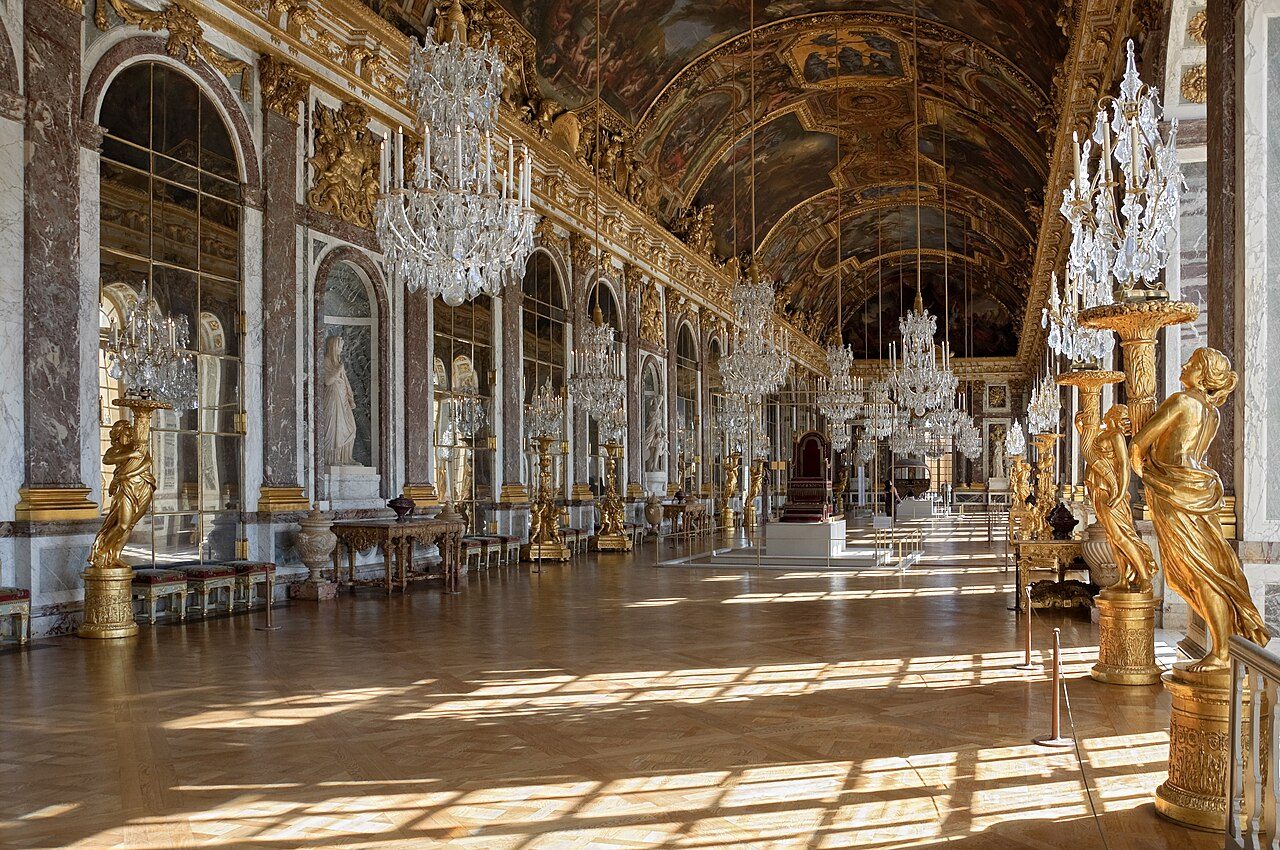
Louis XIV asked his First Architect, Jules Hardouin-Mansart, to replace a run of open terraces on the garden front with a covered gallery. Work began in 1678 and was completed in 1684. The gallery is 73 metres long, 10.5 metres wide and 12.3 metres high. It runs the full width of the central block of the Palace and connects the King's Apartments (to the north) with the Queen's (to the south).
The mirrors
The 578 mirrored panels — arranged in 17 arcades of 21 mirrors each, with additional panels above — were manufactured at the newly founded Manufacture royale des glaces de miroirs. Louis XIV's finance minister, Jean-Baptiste Colbert, had established the works in 1665 specifically to break the Venetian monopoly on mirror-making. Every pane in the Hall of Mirrors was a piece of industrial policy as much as decoration.
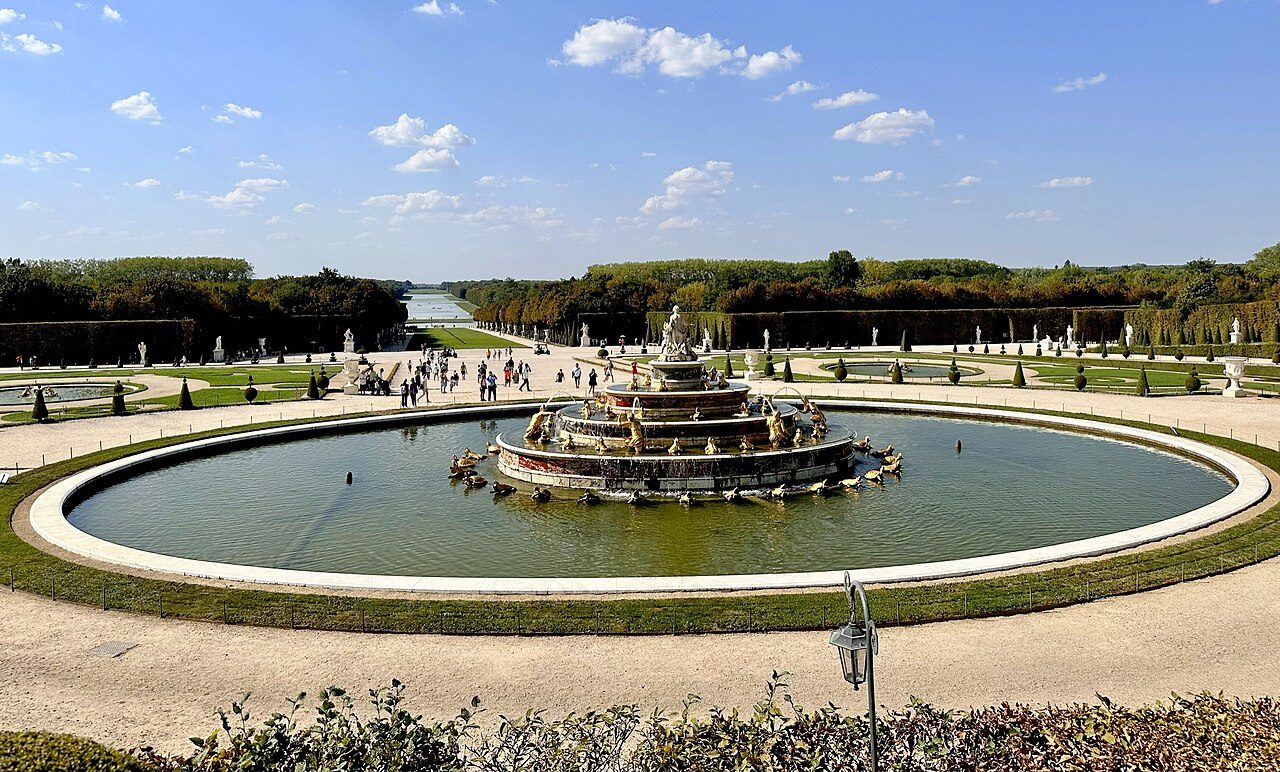
The arcades face 17 arched windows opening onto the gardens. On a bright morning, the room is effectively lit from both walls — the mirrors doubling the daylight and doubling the garden view. This is the effect that seventeenth-century visitors travelled specifically to see.
The ceiling — a reading guide
Charles Le Brun, First Painter to the King, spent five years on the thirty ceiling scenes that run the length of the gallery. They form one long allegorical narrative of Louis XIV's first eighteen years of personal rule (1661–78). Start at the north end (nearest the War Salon) and walk south, reading the ceiling as you go:
- The central panel above the entrance shows the King seizing the reins of government in 1661 upon Mazarin's death.
- Successive scenes depict fiscal reform, the reform of justice, the construction of the fleet and the establishment of the academies of science and painting.
- The middle third depicts the War of Devolution (1667–68) and the conquest of Franche-Comté.
- The southern third — closest to the Peace Salon — depicts the Dutch War (1672–78) and culminates in the Peace of Nijmegen.
Le Brun deliberately painted Louis XIV in Roman rather than contemporary dress in the political scenes. The message was classical, universal, timeless: this is not a French king, this is an emperor.
Objects and furniture
Almost nothing you see on the floor today is original. The gallery's contents were sold or dispersed in the 1793 Revolutionary auctions. The current arrangement — the crystal chandeliers, the silver candelabra, the marble console tables — is a scholarly reconstruction based on inventories of 1691. The chandeliers were remade in 1980 following documentation of the originals.
The room as event space
The Hall of Mirrors was not a museum piece in its own century. It was a working room. Louis XIV used it for the reception of foreign ambassadors: the visitor walked its full length while the entire court watched from the sides, forming an aisle of scrutiny. Winter balls were held here. In 1685 the Doge of Genoa was formally received. In 1686 the ambassador of Siam was.
Two nineteenth- and twentieth-century events fixed the room's modern significance:
- 18 January 1871. Wilhelm I of Prussia was proclaimed the first German Emperor here, at the close of the Franco-Prussian War. The choice of location was a deliberate humiliation of France.
- 28 June 1919. Germany signed the Treaty of Versailles here at the close of the First World War. The choice of location was a deliberate humiliation of Germany.
How to see it well
The room is on every visitor circuit. Between 11am and 3pm in high season it is uncomfortably crowded. There are two remedies. The first is arriving at 9am with a booked entry slot — the room is traversed within the first fifteen minutes of a Palace visit, and you can be inside before the tour groups reach it. The second is the late-afternoon slot after 3.30pm, when the coach parties have left.
Book a 9.00am slot on the official site and enter through the Royal Gate the moment it opens. Photography is permitted (no flash, no tripod).